1,306,192 Meters OF MARINE BARRIERS AND COUNTING  LIVE
LIVE
Solutions for marine pollution control, coastal and shoreline protection to effectively address environmental concerns.
View All Products
Solutions for the protection of critical infrastructure and other high-security areas.
View All Products
End-to-end solutions for environmental protection, safety and security applications that protect, monitor and regenerate marine environments.
View All Solutions
End-to-end marine and engineering services designed to ensure high-performing projects.
View All Services
Industry-focused expertise delivering proven solutions for coastlines and waterways, from initial concept to long-term operation and protection.
View All Industries

Solutions for marine pollution control, coastal and shoreline protection to effectively address environmental concerns.
View All Products
Solutions for the protection of critical infrastructure and other high-security areas.
View All Products
End-to-end solutions for environmental protection, safety and security applications that protect, monitor and regenerate marine environments.
View All Solutions
End-to-end marine and engineering services designed to ensure high-performing projects.
View All Services
Industry-focused expertise delivering proven solutions for coastlines and waterways, from initial concept to long-term operation and protection.
View All Industries

Share:


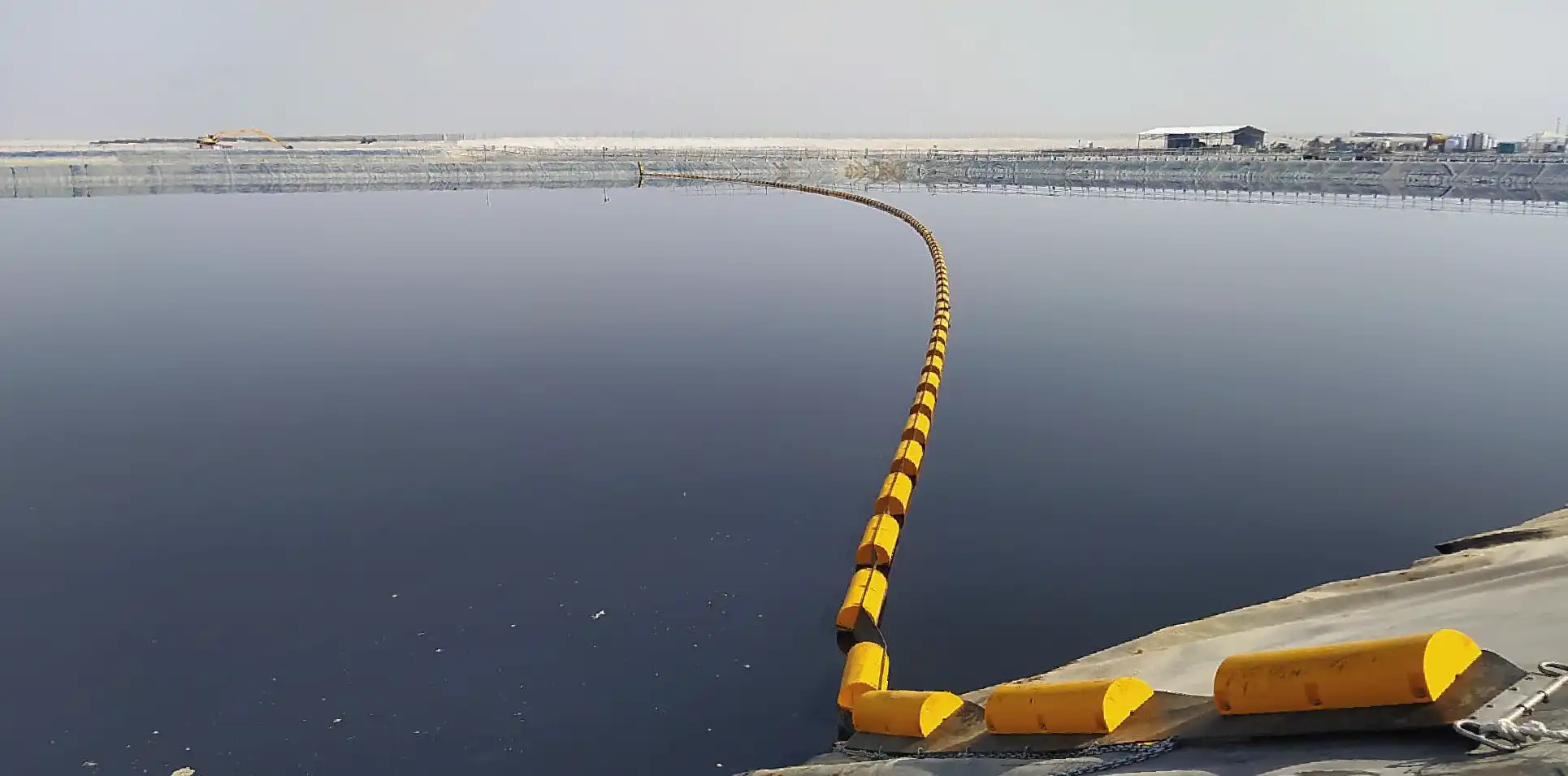
Hydropower is clean energy. However, the plants that generate it are not free of oil spill risk. In fact, every hydropower facility that uses oil-filled transformers carries a regulated contamination hazard. Furthermore, standards bodies like IEEE have recognised this for decades.
So why does the industry rarely talk about what happens when the first line of defence fails?
Hydropower turbines generate electricity. Transformers then increase that voltage for distribution. However, those transformers rely on oil, specifically for insulation and cooling.
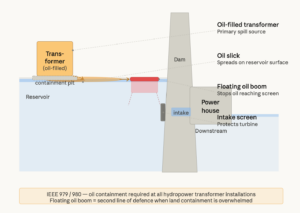
IEEE standard 979 and 980 address this directly. They require hydropower operators to make provisions for transformer oil containment. Specifically, they mandate that containment volumes hold all the oil from a ruptured tank. In addition, they require oil-water separators to handle storm runoff separately from oil spillage.
In other words, the risk is real enough that global engineering standards require a plan for it.
Land-based containment is the first line of defence. It includes containment pits, drain valves and oil-water separators built into the transformer foundations. However, no system is fail-safe.
If a transformer ruptures suddenly, oil can reach the water. Heavy rainfall can overwhelm drainage systems. Construction activity during dam upgrades can compromise existing containment. In any of these scenarios, oil reaches the reservoir, the intake area or the river downstream.
At that point, the land containment has already failed. Therefore, something else needs to stop the spread.
 Where Floating Oil Booms Come In
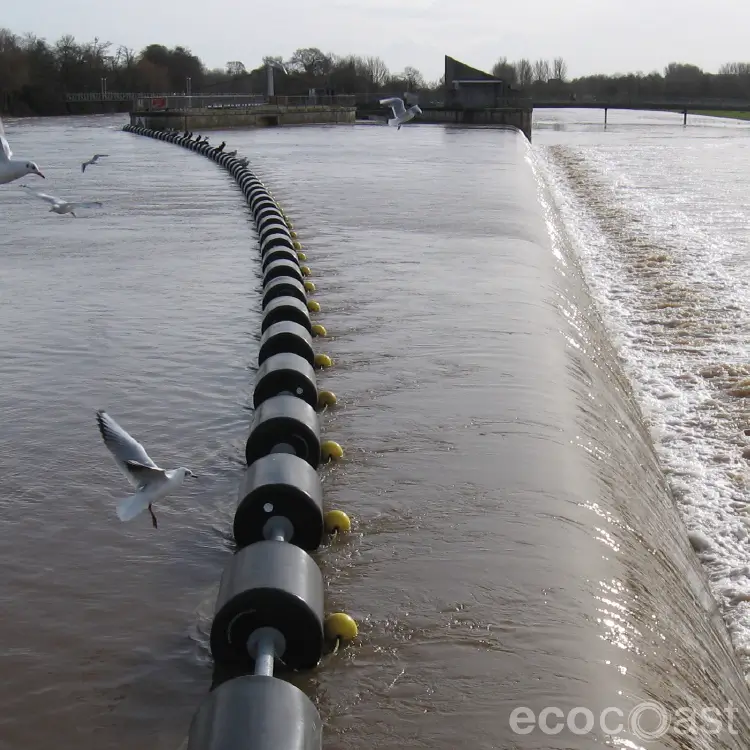
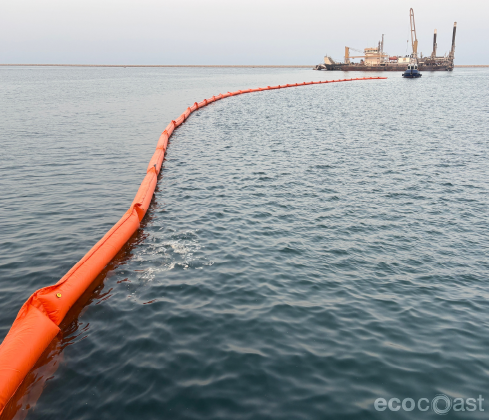
A floating oil boom deploys directly on the water surface. It contains oil before it spreads across the reservoir or reaches critical infrastructure. Specifically, two locations at hydropower plants benefit most from boom deployment.
Intake screens protect turbines from debris and contamination. However, they are also a point of vulnerability. If oil reaches a screen, it fouls the mesh and risks entering the turbine system. A floating oil boom positioned in front of the screen acts as a barrier. It stops oil before it ever reaches that critical point.
Not every hydropower operator keeps booms permanently installed. However, rapid deployment capability is essential. When an incident occurs, response time is critical. Inflatable oil booms store compactly on reels and deploy in minutes. Therefore, they provide an effective emergency response option even where permanent installation is not feasible.
The Bipartisan Infrastructure Law and the Water Resources Development Act (WRDA) are driving a new wave of dam upgrades across the United States. Specifically, over USD 800 million targets dam safety and rehabilitation works.
During active construction, oil spill risk at dam sites increases significantly. Heavy machinery, fuel systems and hydraulic equipment all operate near the water. Moreover, existing containment infrastructure may be temporarily disrupted during works.
Consequently, this is exactly the moment to have the right response equipment in place. Not after an incident. Before it.
Not all oil booms suit every application. For hydropower sites, specifically consider:
Reservoir conditions – Calm, freshwater environments differ from open marine conditions. Boom selection should reflect the specific site conditions.
Deployment speed – Inflatable booms on reels allow rapid deployment with minimal crew. This is critical for emergency response.
Storage footprint – Space at dam sites is often limited. Compact storage matters.
Durability – Booms at hydropower sites may face debris, seasonal water level changes and UV exposure. Material quality is therefore essential.
–
At Ecocoast, we supply Ecobarrier Inflatable Oil Booms and Bolina Harbour Oil Booms suitable for reservoir environments. Our team works with operators to specify the right solution for each site – before an incident makes the decision urgent. Get in touch to know more.
Share:

Hydropower plants use oil-filled transformers for insulation and cooling. IEEE standards 979 and 980 require operators to contain any oil leakage or spillage. The goal is to prevent oil from reaching waterways or contaminating soil around transformer foundations.
Transformer oil is toxic to aquatic life. If it reaches a reservoir or river, it contaminates the water supply and harms ecosystems downstream. It can also foul turbine intake screens, disrupting power generation. Rapid containment is therefore essential.
Yes. During dam upgrade and rehabilitation works, heavy machinery and fuel systems operate near the water. Moreover, existing containment infrastructure may be disrupted. Floating oil booms provide an additional layer of protection during this period.
Hydropower plants use oil-filled transformers for insulation and cooling. IEEE standards 979 and 980 require operators to contain any oil leakage or spillage. The goal is to prevent oil from reaching waterways or contaminating soil around transformer foundations.
Transformer oil is toxic to aquatic life. If it reaches a reservoir or river, it contaminates the water supply and harms ecosystems downstream. It can also foul turbine intake screens, disrupting power generation. Rapid containment is therefore essential.
Yes. During dam upgrade and rehabilitation works, heavy machinery and fuel systems operate near the water. Moreover, existing containment infrastructure may be disrupted. Floating oil booms provide an additional layer of protection during this period.