Ready to green your grey infrastructure? Discover Ecoreef →
1,333,018 Meters OF MARINE BARRIERS AND COUNTING  LIVE
LIVE
Solutions for marine pollution control, coastal and shoreline protection to effectively address environmental concerns.
View All Products
Solutions for the protection of critical infrastructure and other high-security areas.
View All Products
End-to-end solutions for environmental protection, safety and security applications that protect, monitor and regenerate marine environments.
View All Solutions
End-to-end marine and engineering services designed to ensure high-performing projects.
View All Services
Industry-focused expertise delivering proven solutions for coastlines and waterways, from initial concept to long-term operation and protection.
View All Industries

Solutions for marine pollution control, coastal and shoreline protection to effectively address environmental concerns.
View All Products
Solutions for the protection of critical infrastructure and other high-security areas.
View All Products
End-to-end solutions for environmental protection, safety and security applications that protect, monitor and regenerate marine environments.
View All Solutions
End-to-end marine and engineering services designed to ensure high-performing projects.
View All Services
Industry-focused expertise delivering proven solutions for coastlines and waterways, from initial concept to long-term operation and protection.
View All Industries

Share:


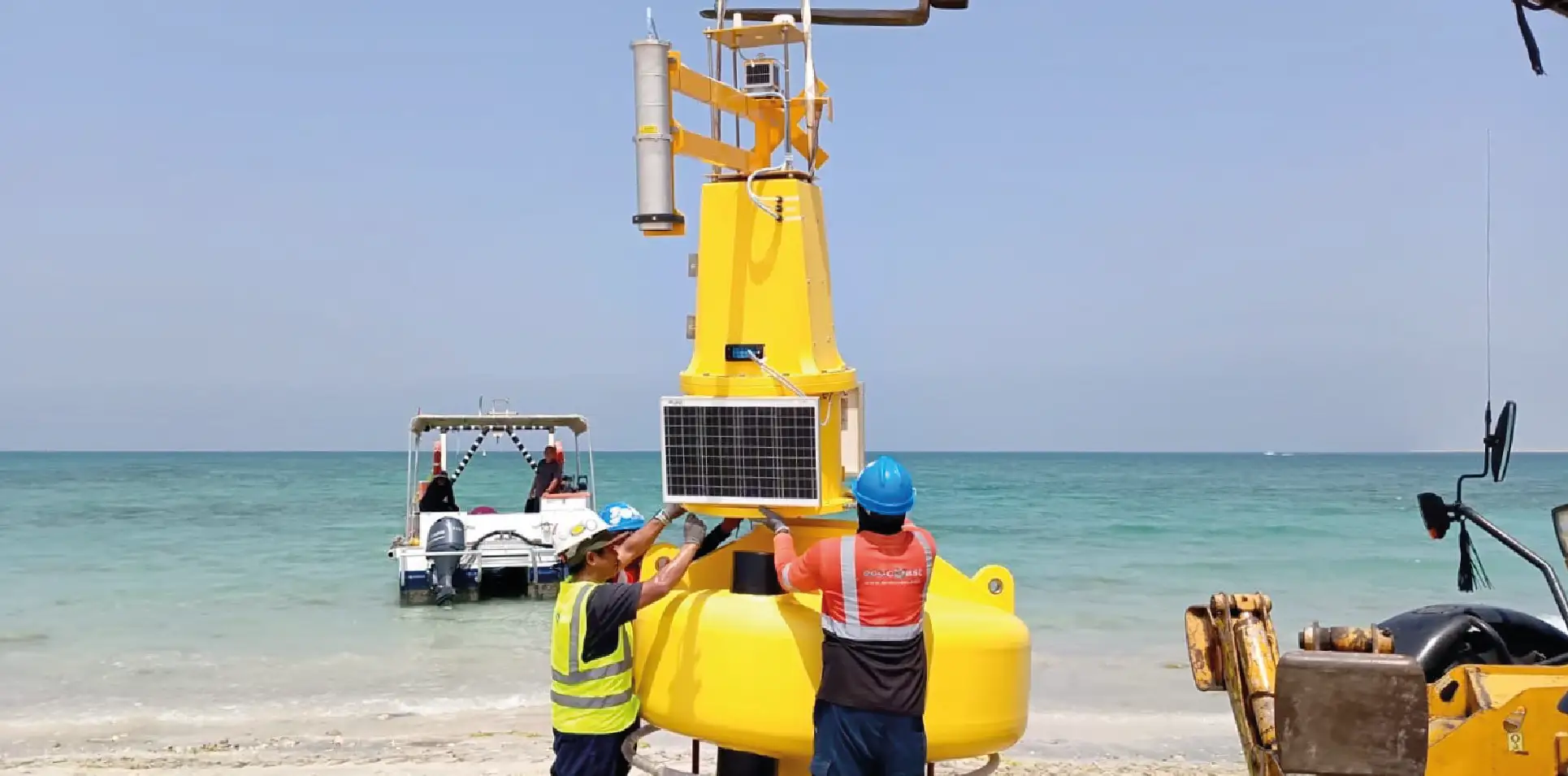
Continuous water quality monitoring records six core parameters at fixed intervals, around the clock: Temperature, dissolved oxygen, pH, salinity, conductivity and turbidity. A sensor left in the water logs each one every 15 minutes. That produces roughly 2,900 readings a month from a single location, against the one reading a monthly sampling visit produces.
That difference in resolution is the entire point. It’s worth understanding parameter by parameter.
World Water Monitoring Day, run by EarthEcho International, started with a simple proposition. Anyone should be able to find out what’s in their local water. More people testing more water leads to better decisions.
It has grown into a global citizen science effort spanning more than 100 countries.
The principle holds at every scale. A student with a test kit in a river and an instrumented buoy in a working marina are asking the same question. What’s in this water, right now, and is it getting better or worse?
The most straightforward reading, and often the most consequential. Warm water holds less oxygen. Rising temperature therefore compounds every other risk in this list.
In the Gulf, summer water temperatures sit close to regional guiding limits for months at a time. That makes the trend more informative than any single reading.
The oxygen available to marine life, reported in mg/l and as a percentage of saturation. Oxygen follows a daily cycle. It falls overnight as organisms respire, then recovers through the day as photosynthesis resumes.
A healthy site has a modest daily swing. A widening swing is one of the earliest signs of nutrient enrichment.
How acidic or alkaline the water is. Seawater is naturally slightly alkaline, typically 7.5 to 8.4. Sharp short-lived shifts can indicate detergents or cleaning chemicals entering the water. Slow drift over months is a different signal entirely.
Conductivity measures how well water carries an electrical current. It rises with dissolved salts, and salinity is calculated from it.
Together, they’re useful less for their own sake than as a reference. An unexplained change in conductivity alongside a fall in oxygen is a classic discharge signature.
How much suspended material is in the water, measured in NTU. Turbidity spikes when sediment is disturbed, during dredging, watercraft manoeuvring or heavy weather.
Sustained elevation, rather than a spike, usually points to something biological.
No single parameter tells you much on its own. The value is in reading them against each other.
A periodic sample captures a moment. If that moment falls at midday, it will not show the oxygen minimum that occurs at 4am. If it falls in a calm week, it will not show the turbidity event during the previous week’s dredging.
The practical consequence is straightforward. A site can pass every scheduled test while experiencing conditions that would fail one, simply because nobody was measuring when they occurred.
In one Gulf marina basin we monitor continuously, oxygen ran from supersaturation in the afternoons to below 3 mg/l before dawn. Turbidity rose alongside it. That swing is what a developing algal bloom looks like.
It built, ran its course and cleared within about a week. A monthly sample taken before it started would have come back normal. So would one taken after it finished.
For a marina, a port or a coastal development, the argument is not that continuous monitoring produces more data. It’s that it produces data in time to act on.
An oxygen crash flagged overnight is an operational decision. Move a vessel, pause a shift, check what’s happening upstream. The same event found in a report three weeks later is a record of something you could not prevent.
That distinction matters more each year. Water temperatures in the region are trending upwards. The pressures that come with them, reduced oxygen capacity and elevated bloom risk, are becoming seasonal rather than exceptional.
Look at it properly. Across the Gulf, there’s still a great deal of coastline where nobody has asked what’s in the water. The first step towards protecting any of it, is measuring it.
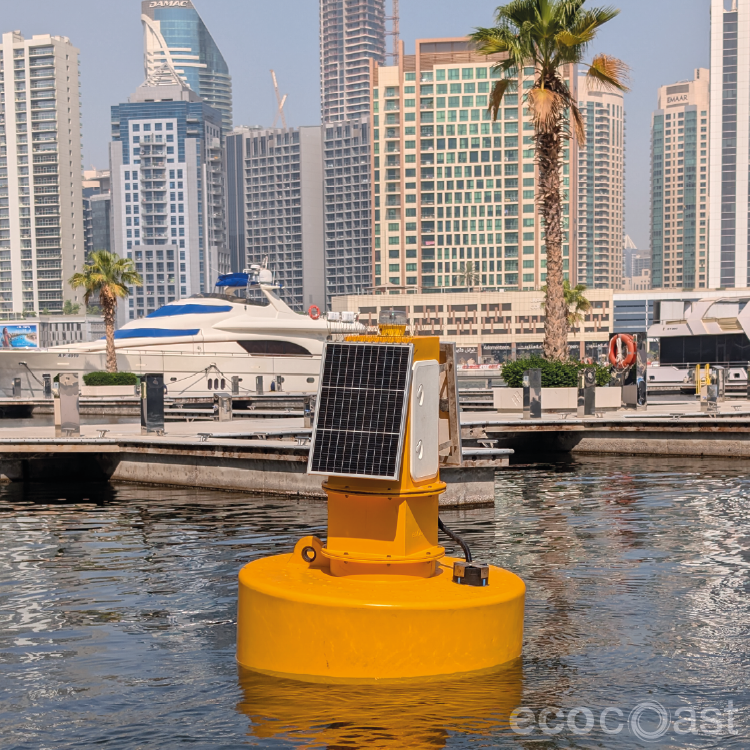
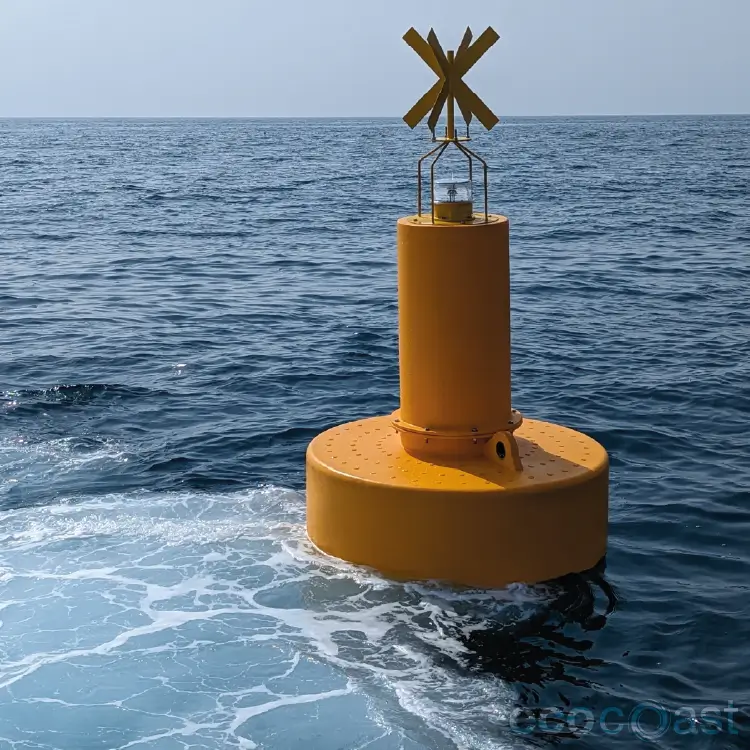
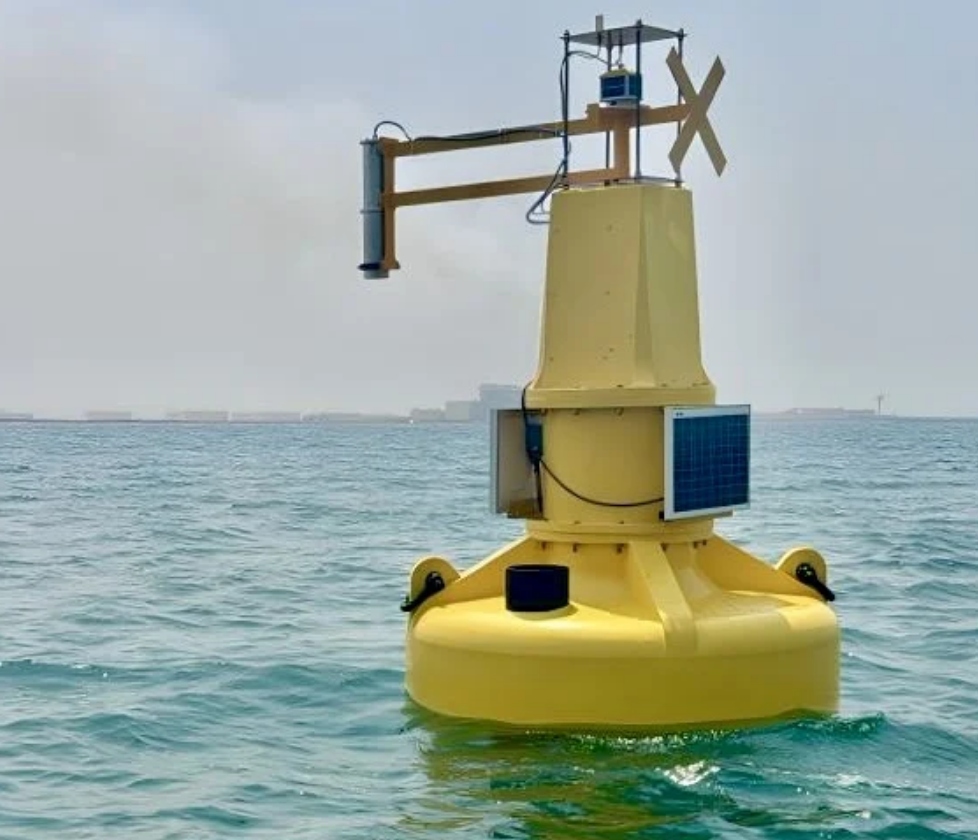
Ecocoast designs and deploys environmental monitoring systems across the Gulf, including data buoys. Talk to our team about what monitoring at your site would involve.
Share:

Continuous water quality monitoring is the use of an in-situ sensor to record water parameters at fixed intervals, typically every fifteen minutes, rather than collecting samples periodically. It produces a complete time series instead of isolated snapshots.
A standard multi-parameter sonde measures temperature, dissolved oxygen, pH, salinity, conductivity and turbidity. Additional sensors can be fitted for chlorophyll, hydrocarbons, ammonium and other specific indicators.
It depends on what you need to detect. Compliance reporting is often satisfied by monthly sampling. Events such as oxygen crashes, discharge incidents and developing algal blooms occur on timescales of hours, and are routinely missed by periodic sampling.
Dissolved oxygen is the oxygen available in water for marine life, reported in mg/l and as a percentage of saturation. Sustained low levels cause stress and mortality in fish and invertebrates. Low readings are one of the earliest indicators that a water body is under pressure.
World Water Monitoring Day is held annually on 18 September and is run by EarthEcho International. It encourages people worldwide to test their local water and share the results, building a public picture of water quality across more than a hundred countries.
Continuous water quality monitoring is the use of an in-situ sensor to record water parameters at fixed intervals, typically every fifteen minutes, rather than collecting samples periodically. It produces a complete time series instead of isolated snapshots.
A standard multi-parameter sonde measures temperature, dissolved oxygen, pH, salinity, conductivity and turbidity. Additional sensors can be fitted for chlorophyll, hydrocarbons, ammonium and other specific indicators.
It depends on what you need to detect. Compliance reporting is often satisfied by monthly sampling. Events such as oxygen crashes, discharge incidents and developing algal blooms occur on timescales of hours, and are routinely missed by periodic sampling.
Dissolved oxygen is the oxygen available in water for marine life, reported in mg/l and as a percentage of saturation. Sustained low levels cause stress and mortality in fish and invertebrates. Low readings are one of the earliest indicators that a water body is under pressure.
World Water Monitoring Day is held annually on 18 September and is run by EarthEcho International. It encourages people worldwide to test their local water and share the results, building a public picture of water quality across more than a hundred countries.