Ready to green your grey infrastructure? Discover Ecoreef →
1,333,018 Meters OF MARINE BARRIERS AND COUNTING  LIVE
LIVE
Solutions for marine pollution control, coastal and shoreline protection to effectively address environmental concerns.
View All Products
Solutions for the protection of critical infrastructure and other high-security areas.
View All Products
End-to-end solutions for environmental protection, safety and security applications that protect, monitor and regenerate marine environments.
View All Solutions
End-to-end marine and engineering services designed to ensure high-performing projects.
View All Services
Industry-focused expertise delivering proven solutions for coastlines and waterways, from initial concept to long-term operation and protection.
View All Industries

Solutions for marine pollution control, coastal and shoreline protection to effectively address environmental concerns.
View All Products
Solutions for the protection of critical infrastructure and other high-security areas.
View All Products
End-to-end solutions for environmental protection, safety and security applications that protect, monitor and regenerate marine environments.
View All Solutions
End-to-end marine and engineering services designed to ensure high-performing projects.
View All Services
Industry-focused expertise delivering proven solutions for coastlines and waterways, from initial concept to long-term operation and protection.
View All Industries

Share:


Choosing a marine barrier supplier looks simpler than it is. A line of floats, a skirt, some connectors, a mooring arrangement. On a spec sheet, two quotes for the same project can look almost identical. Then one of them goes in the water.
The difference shows up later. A silt curtain tears at the ballast seam. A debris boom overtops in the first serious flow event. A mooring drags because nobody modeled the actual seabed. By then the barrier is no longer the problem. The delayed program is. The environmental non-compliance is. The replacement mobilization is.
Tender stage decides most of that risk, long before anything is manufactured. These are the seven questions to put to any marine barrier supplier while you can still act on the answers.
This is the fastest way to tell two suppliers apart, and you can do it before committing to anything.
Many suppliers respond to a tender with a price and a datasheet. That is the whole submission. The engineering, if it happens at all, happens after the order lands – or gets quietly pushed back to your consultant.
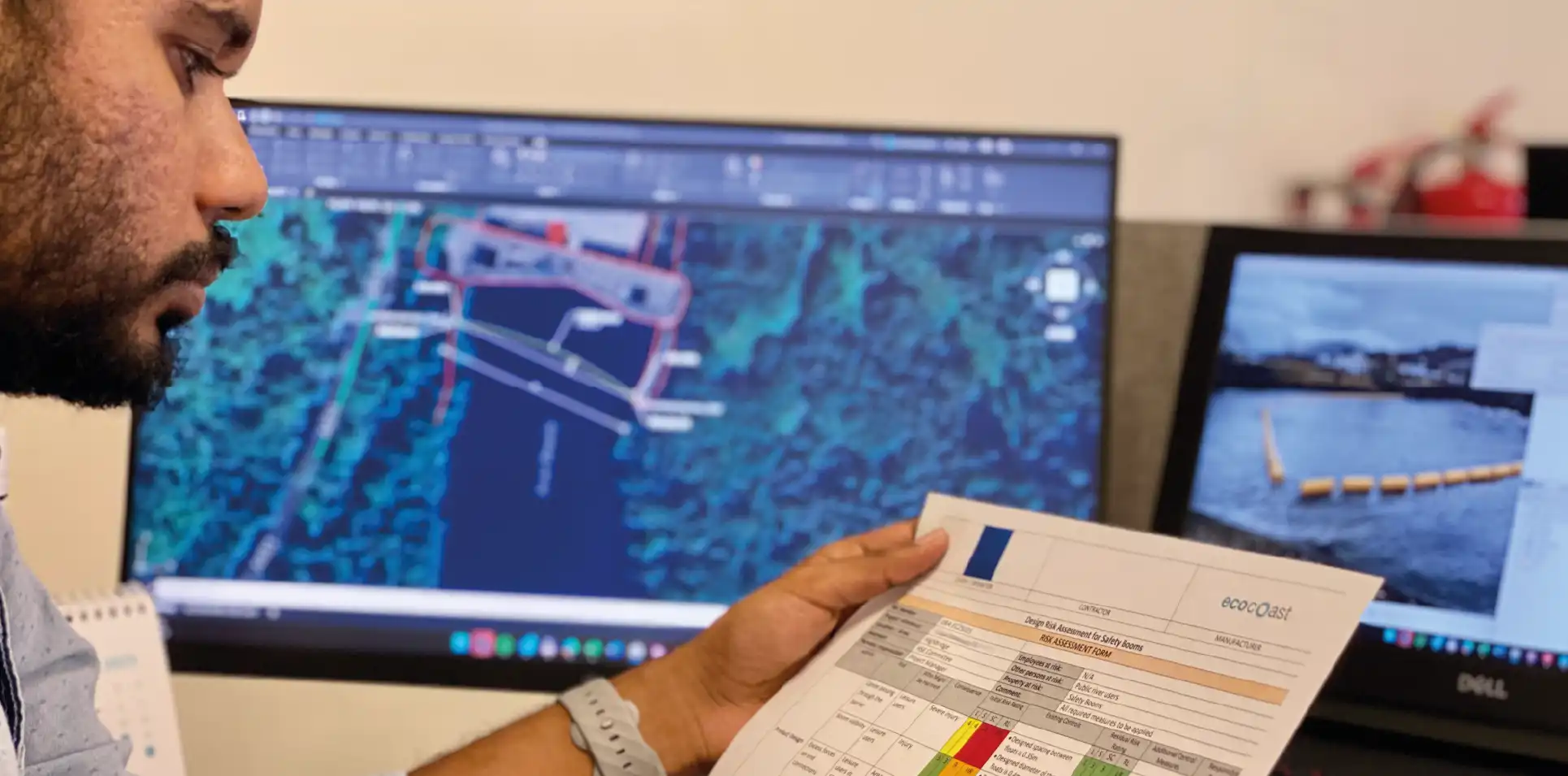
A supplier who engineers their own systems can send you two things at tender stage. A layout drawing, so you can see the arrangement in your actual site before it exists. And a calculation report showing the environmental loads, the resulting forces and the anchoring designed to hold them. Those documents let your consultant check the design rather than take it on trust.
Ask this
Can you provide a layout drawing and a load calculation report at tender stage, before I place an order? If not, at what point in the project does the engineering happen, and who pays for it?
The answer separates suppliers immediately. One group says yes and attaches them. The other explains why it is not normally included.
A calculation report is only as good as the method behind it. So ask what produced it.
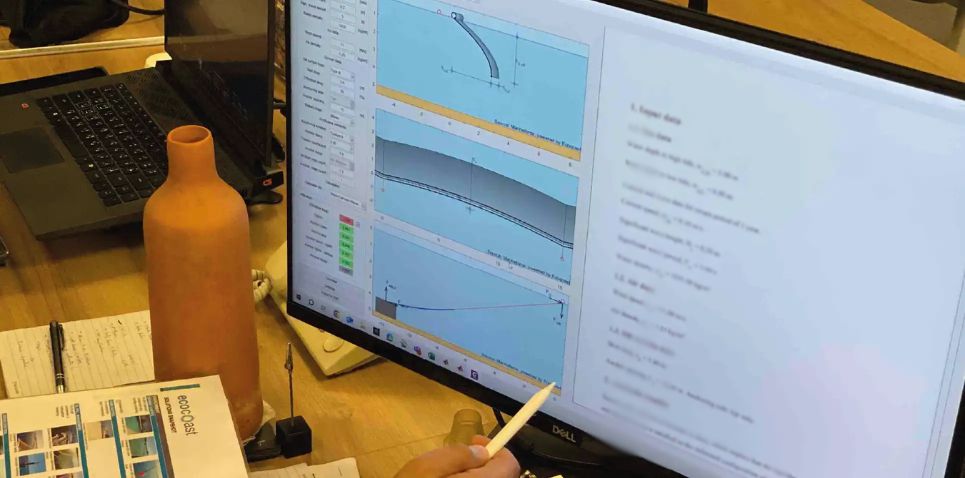
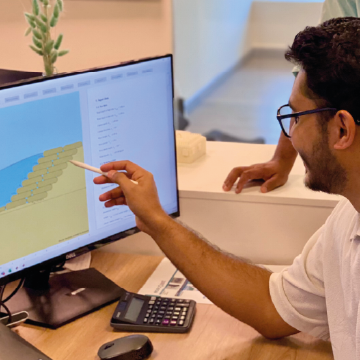
The strongest answer is a modeled one. A digital version of your barrier, built to your site conditions, loaded with your current velocities, wave heights, depths and tidal range, then run to see how the structure and its moorings behave. You find the failure point in software rather than in the water.
What makes that modeling trustworthy is not the software itself. It is what has gone into it. A simulation calibrated against years of real installations – the ones that performed and the ones that taught something – predicts behavior far better than one built on theory alone. This is the part of marine engineering that cannot be shortcut or acquired quickly. It accumulates. Industry guidance from bodies such as PIANC sets out why site-specific load assessment matters for floating marine structures.
Ask this
How was this design modeled, and what real project data sits behind the model? What changes in the output if the peak current is 2 knots instead of 1?
A concrete answer means somebody has modeled it. A vague one means somebody will find out during installation.
Almost every marine barrier supplier will tell you they have engineering capability. The useful follow-up is how much, and of what kind.
There is a real difference between a company where one or two people carry the technical load and a company with a standing multi-discipline team. It shows up in ordinary ways. Do your calculations come back in days or weeks? Can anyone answer a design query while the lead engineer is on site? Will two of your projects run properly in parallel? And in three years, when you call about an extension, is the person who specified your barrier still there?
Depth is also what turns a design into a design review. Structural, mooring and materials decisions get checked by someone other than the person who made them. That internal challenge is invisible in the quote and decisive in the water.
Ask this
How many engineers are on the team, what are their disciplines, and who reviews the design before it is issued? Who is my technical contact if that person is unavailable?

Unit price and whole-life cost are very different numbers. Marine environments are unusually good at exposing the gap. UV, salt, abrasion, biofouling and constant cyclic loading punish every shortcut in material selection.
Look specifically at four things:
Then ask for the evidence. Material claims are easy to make and slow to disprove, which is why a long-service reference is worth more than any datasheet. It is also the one thing a marine barrier supplier cannot produce early. Field history only exists if the field history exists.
Ask this
Show me three projects in conditions comparable to mine, and at least one system still in service after five years or more. Who was the client, and how has it performed since?
That question separates a track record from a portfolio.
Want a second opinion on a specification you have already received?
Plenty of barriers fail not because the product was wrong, but because the installation was. Anchor placement, tensioning, connection sequencing and commissioning under load all matter. All of it is easy to get wrong when the supplier has already moved on.
So find out what the handover actually consists of. A crate of equipment and a delivery note is one version. A documented, risk-assessed, installable system is another. Use the list below as your checklist – the second column is the one to fill in for whoever else you are evaluating.
| Should arrive as standard | Ecocoast | Other quote |
|---|---|---|
| Layout drawings at tender stage | ✓ | |
| Load and anchoring calculation report | ✓ | |
| Assembly manual | ✓ | |
| Installation manual | ✓ | |
| Maintenance manual with inspection intervals | ✓ | |
| Product risk assessment | ✓ | |
| Method statements and site risk assessments (consultant-supervised installations) | ✓ | |
| Operator training, theory and hands-on | ✓ | |
| Engineering support on call after handover | ✓ |
Print this section and take it into your next supplier call.
Training deserves a particular mention. Equipment that nobody on site is confident operating tends to be deployed late, deployed wrong, or not deployed at all – which is the worst possible outcome for a system bought as a contingency measure.
This one is easy to overlook, because it appears nowhere in a quote. Ask it anyway.
Some suppliers build what the category already has. Their designs follow whatever is proven elsewhere, which means they are always working from an answer somebody else arrived at. Others run their own testing, invest in development, and change the design when the evidence says to.
The practical consequence is simple. When your site presents something the category has not solved yet, one type of supplier can engineer a response. The other can offer you the existing product and hope. Independent verification is the tell – third-party witnessed testing against a published standard, such as those maintained by ASTM International, costs real money and produces a document you can request and check.
Ask this
What has changed in this product over the last five years, and why? What independently witnessed testing supports it, and can I have the reports for my tender submission?
If one quote comes in significantly cheaper, that gap is telling you something specific. It is worth finding out what. The savings have to come from somewhere, and by this point in the list the candidates are obvious:
None of these are visible at handover. All of them are visible within no time after installation. And several become your cost the moment your consultant asks for calculations that do not exist.
So the right question is not why they are cheaper. It is what has been left out, and who pays for it later. Sometimes the honest answer is that you do not need everything the fuller quote includes, and that is a perfectly good reason to take the cheaper one. You should be choosing to leave it out, though, rather than discovering afterwards that it was never there.
We keep engineering in-house, with a full multi-discipline marine engineering team rather than a single technical contact. Every solution is modeled in Ecocoast® Marineforce, Geoforce or Moorforce, our own simulation software, calibrated against more than a decade of real installations across more than 50 countries. That is what allows us to issue layout drawings and calculation reports at tender stage, before you have committed to anything.
Everything in the table above ships as standard, on every project. Manuals, risk assessments, training, and engineers who are still reachable after handover. No hidden extras.
We are not always the cheapest quote on the table. As a marine barrier supplier, we would rather show you exactly what is in ours, and let you compare it line by line.
You will get a layout drawing and a calculation report – not just a datasheet page.
Share:

At tender stage, a layout drawing and a load and anchoring calculation report. At delivery, assembly, installation and maintenance manuals plus a product risk assessment. For consultant-supervised installations, method statements and site risk assessments. Operator training and post-handover engineering support should also be included rather than charged as extras.
Usually because of scope rather than product. Engineering hours, site-specific mooring design, material grade, documentation, training, installation supervision and aftercare are the common differences. A lower price often reflects a narrower scope or lower material specs, and the missing elements become the buyer's cost later.
Yes. Marine barriers are load-bearing structures, and the loads come from the site. Current velocity, wave climate, water depth, tidal range, seabed type and debris load all change the required configuration and the mooring arrangement.
At tender stage, a layout drawing and a load and anchoring calculation report. At delivery, assembly, installation and maintenance manuals plus a product risk assessment. For consultant-supervised installations, method statements and site risk assessments. Operator training and post-handover engineering support should also be included rather than charged as extras.
Usually because of scope rather than product. Engineering hours, site-specific mooring design, material grade, documentation, training, installation supervision and aftercare are the common differences. A lower price often reflects a narrower scope or lower material specs, and the missing elements become the buyer's cost later.
Yes. Marine barriers are load-bearing structures, and the loads come from the site. Current velocity, wave climate, water depth, tidal range, seabed type and debris load all change the required configuration and the mooring arrangement.






 Prev Blog